How Big Tech Distributes Data: A Beginner-Friendly Guide to Consistent Hashing
A Step-by-Step Journey from Simple Caching to Resilient Distributed Systems
"Whether it's streaming on Prime Video, sending a message on WhatsApp, or scrolling Instagram, how does a system decide which server handles your request — without melting down every time a server is added or removed?" When an app grows to millions of users, a single computer cannot handle all the traffic alone. You have to divide the workload across a team of dozens or hundreds of servers.
The challenge is: how do you divide the work fairly, find any piece of data instantly, and handle server crashes without chaos?
The technique behind how modern tech giants solve this is an elegant concept called Consistent Hashing.
In this guide, we’ll break this down in four clear stages:
1. The Core Problem: Why traditional sharding and modulo hashing (% N) break down when clusters resize.
2. The Elegant Fix: How a circular "hash ring" and virtual nodes keep systems stable and evenly balanced.
3. Production Realities: Deduplicated replication, rack/AZ failure domains, nanosecond binary search lookups, and hot-key spillover.
4. Real-World Systems & Interview Mastery: Real-world usage in Cassandra, DynamoDB, and LLM inference clusters, plus a battle-tested 5-step interview blueprint.
Part 1: The Problem — Why Traditional Sharding Fails
Step 1: The Problem — One Server Is Not Enough
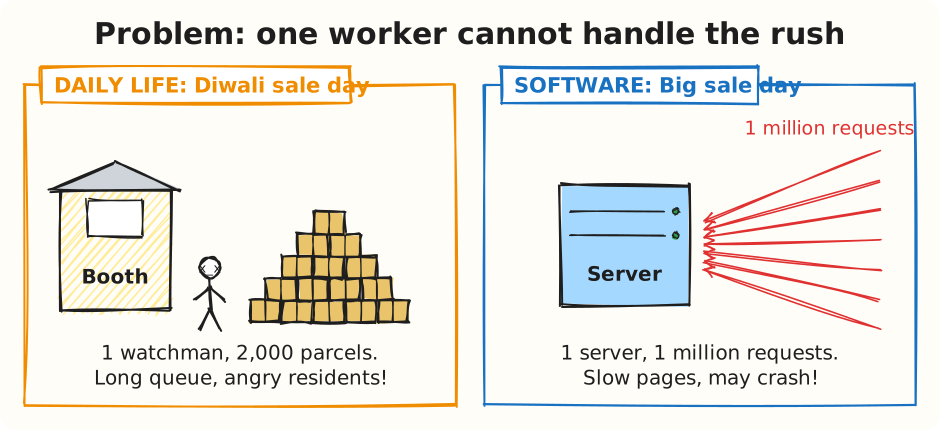
🏢 Apartment Parcel Counter at Rush Hour
Imagine a large apartment complex with a single parcel desk. On a normal day, 20 deliveries arrive and the guard can sort them without stress.
Then comes a festival sale or a big shopping season. Suddenly, 2,000 parcels arrive in just a few hours. One desk cannot keep up. Residents queue up, parcels are mis-routed, and everyone gets frustrated.
The management adds 4 parcel counters: Counter A, B, C, and D.
Now the real problem appears:
Which counter should a resident visit to collect their parcel?
If everyone guesses randomly, a resident may go to Counter C and find the parcel is not there. They then have to look at A or B, causing delay and confusion.
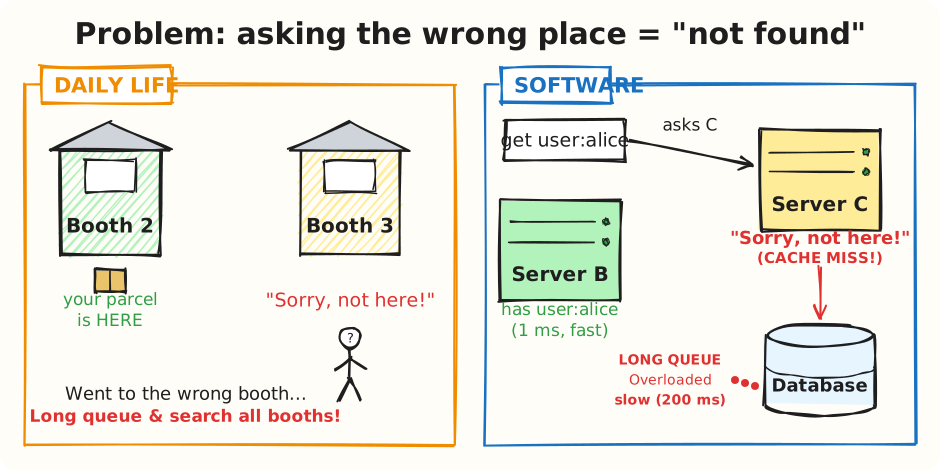
💻 The Real Software Equivalent: Where Did We Store the Data?
In software, servers are just like those parcel counters.
When an app grows from 1,000 users to 10 million, a single computer runs out of memory (RAM) and CPU. To handle the rush, you split the load across 4 servers: Server A, B, C, and D.
Now your application faces the exact same dilemma:
* The Resident Looking for a Parcel: When Alice opens the app and requests her shopping cart (user:alice), which of the 4 servers is holding her cart?
* Checking the Wrong Counter (Cache Miss): If your app mistakenly asks Server C, but Alice's data was saved on Server A, Server C replies: "Sorry, not here!"
* The Long Queue (Database Overload): Just like a resident having to wait in a long queue outside the watchman's room while the guard slowly digs through a mountain of unsorted boxes in the back storage room, your app now has to fetch that data from the slow main database on disk. If millions of users hit the wrong server at once, the database melts down under the load, and users stare at endless spinning loading wheels.
| Requirement | Apartment Parcel Counter | Distributed Software System |
|---|---|---|
| Predictability | A resident knows exactly which counter to walk to | The app knows instantly which server holds Alice's data without searching |
| Even Distribution | Parcels are spread fairly so Counter A isn't flooded while D is empty | Memory and traffic are spread evenly across all servers |
| Fault Tolerance | If Counter B closes for lunch, the whole building doesn't grind to a halt | If Server B crashes, the app keeps running smoothly |
Step 2: What Is Hashing?
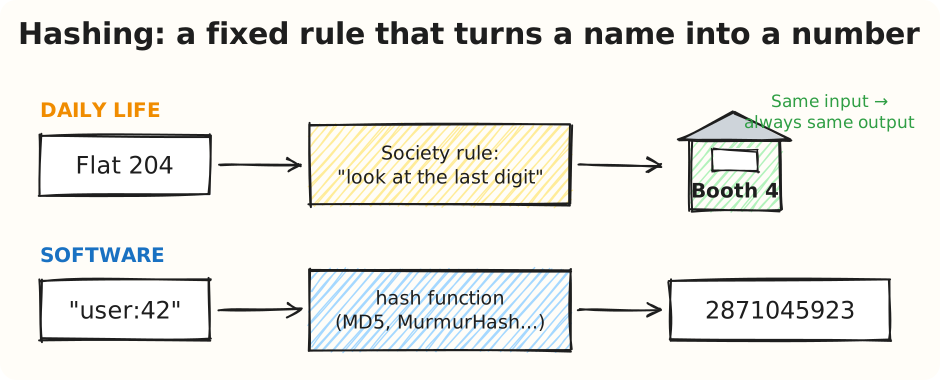
📚 Daily Routine: The Apartment Flat Number Rule
The apartment management creates a simple rule:
"Take the last digit of the flat number. A flat ending in 0 goes to Counter 0, ending in 1 goes to Counter 1, and so on."
If you live in Flat 204, you immediately know which counter to visit. The rule is deterministic, fast, and does not require asking anyone.
💻 Real Software Counterpart: Hash Functions
In software, a hash function converts an arbitrary input such as a user ID, session key, URL, or session token into a fixed-size number.
A good hash function for distributed systems (such as MurmurHash3, xxHash, or MD5) guarantees:
1. Deterministic: Given "user:42", it always returns the exact same number every single time.
2. Uniform Distribution: It scatters output numbers evenly across the entire range, with no clustering.
3. High Speed: It computes in nanoseconds.
Step 3: The Naive Approach — Modulo Hashing (% N)
The most obvious way to map a large hash number to 4 servers is using the modulo operator (%):
Where \(N\) is the number of servers (e.g., 4 servers: index 0, 1, 2, 3).
This works smoothly when the server count never changes. But in production, server counts constantly fluctuate — engineering teams add machines to handle shopping rushes like Black Friday or festival sales, remove them at night to save cloud costs, or machines unexpectedly crash.
💥 The Catastrophe: Adding Just ONE Server
Traffic spikes on Black Friday. We add a 5th server (\(N=5\)):
Where did the numbers come from? In the code above, we saw
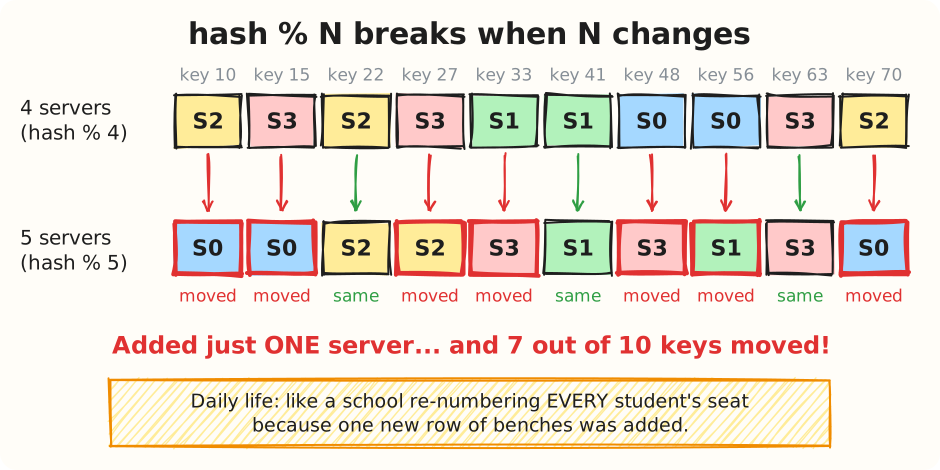
hash("user:42"). To make calculations easy to follow without dealing with giant 10-digit numbers (like2871045923), let's look at 10 different user accounts (likeuser:10,user:15,user:22,user:27... up touser:70) and assume their hash values are simply those exact numbers: *hash("user:10") = 10*hash("user:15") = 15*hash("user:27") = 27(shown askey 27in the diagram below) * ... and so on.
Now, see what happens to these 10 users' parcels when we add that 5th server:
| Key | Hash Value | Old Node (% 4) |
New Node (% 5) |
Status |
|---|---|---|---|---|
user:10 |
10 | Server 2 | Server 0 | ❌ Moved |
user:15 |
15 | Server 3 | Server 0 | ❌ Moved |
user:22 |
22 | Server 2 | Server 2 | ✅ Remained |
user:27 |
27 | Server 3 | Server 2 | ❌ Moved |
user:33 |
33 | Server 1 | Server 3 | ❌ Moved |
user:41 |
41 | Server 1 | Server 1 | ✅ Remained |
user:48 |
48 | Server 0 | Server 3 | ❌ Moved |
user:56 |
56 | Server 0 | Server 1 | ❌ Moved |
user:63 |
63 | Server 3 | Server 3 | ✅ Remained |
user:70 |
70 | Server 2 | Server 0 | ❌ Moved |
7 out of 10 keys moved to a completely different server!
🏢 Daily Routine Analogy: Re-numbering the Entire Building
Imagine a block of apartments with 4 parcel counters. The rule is simple:
flat_number % 4
Now the building adds one more counter. The manager announces: "Everyone must recalculate using % 5 and move to a new counter!"
Most residents now have to change counters even though only one new desk was added. This creates chaos and unnecessary movement.
💻 Real Software Nightmare: Cache Stampede
In a real cache cluster with 100,000 keys: - Moving from 4 to 5 servers can remap a large chunk of data. - With many servers, adding or removing even one node can trigger a near-total reshuffle. - Most requests now miss the cache and hit the database at the same time. - This sudden burst of requests is called a cache stampede or thundering herd, and it can bring the system down.
The Engineering Goal: When we change server count from \(N\) to \(N+1\), we should only move approximately \(\frac{1}{N+1}\) of the keys (the minimum necessary fraction). All other keys must stay exactly where they are.
Part 2: The Core Concept (Intermediate Level)
Step 4: The Big Idea — The Hash Ring
Consistent Hashing solves this problem by getting rid of the modulo division by \(N\).
Instead of mapping keys to a fixed range \(0 \dots (N-1)\), we map both Servers and Data Keys onto a continuous circular ring.
🏢 Daily Routine: The Circular Parcel Lobby
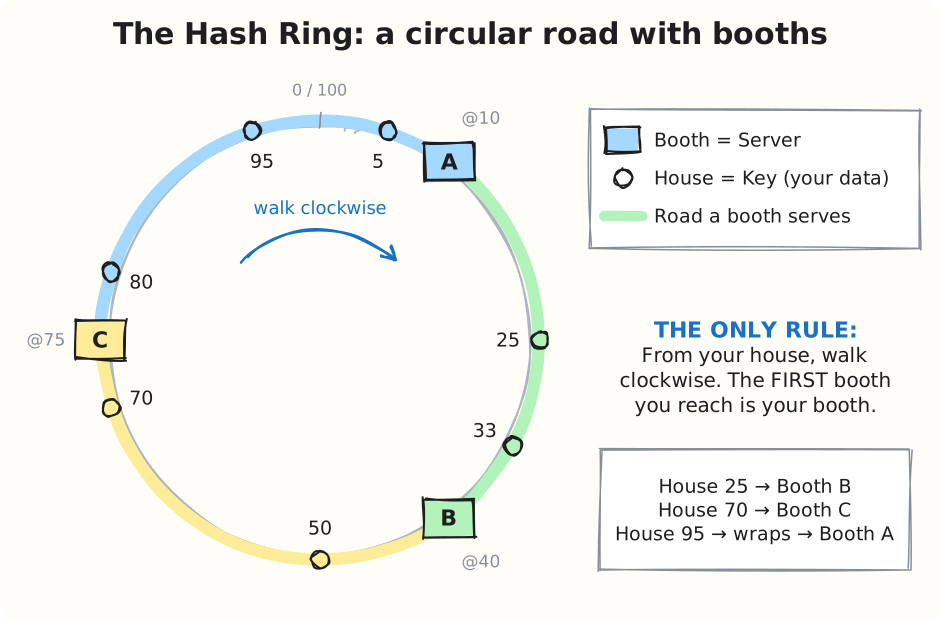
To solve this, imagine the apartment management arranges the parcel counters around a circular lobby numbered from 0 to 99 (like a giant clock).
There are 3 parcel counters set up along the circle: - Counter A is at marker 10 - Counter B is at marker 40 - Counter C is at marker 75
💻 In Software: Server Territories on the Ring
Imagine our ring is numbered from 0 to 99 (like a 100-minute clock).
Step 1: Place the servers on the ring
We hash each server's name to give it a fixed position:
* hash("Server-A") = 10
* hash("Server-B") = 40
* hash("Server-C") = 75
Step 2: Each server owns a slice of the ring (Clockwise)
Because we always assign keys clockwise, each server simply owns the territory leading up to it:
| Server | Position on Ring | Territory / Keys It Owns |
|---|---|---|
| Server B | 40 | Owns 11 to 40 |
| Server C | 75 | Owns 41 to 75 |
| Server A | 10 | Owns 76 to 99, looping past 0 up to 10 |
🎬 What Actually Happens in Production (e.g. Amazon Prime or Instagram)
What is a "Router"?
A router (or API Gateway / Load Balancer) is like the watchman sitting at the building's front lobby desk. It does not store the video files itself. Instead, its only job is to greet incoming requests from millions of phones and instantly direct each user to the exact server that has that data loaded in memory.
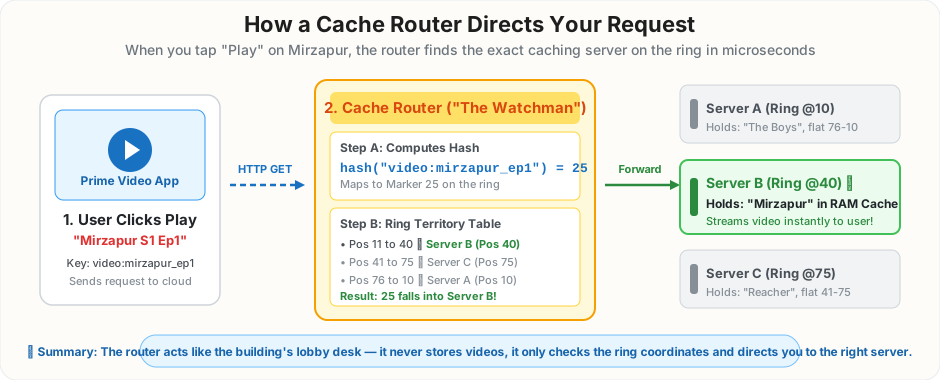
The router keeps the ring coordinates in its local memory. Here is what happens when users click around the app:
- User clicks "Play" on "Mirzapur" in Prime Video:
- The app asks: "Give me the video file for Mirzapur Episode 1!" (
video:mirzapur_ep1). - The router hashes the show's title:
hash("video:mirzapur_ep1") = 25. -
On the ring, position
25falls inside the11 to 40territory ➔ The router connects the user straight to Server B, which streams the video without buffering. -
Another user clicks "Play" on "Reacher":
- The router hashes the video ID:
hash("video:reacher_s2e1") = 60. -
On the ring,
60falls into41 to 75➔ Directed to Server C. -
A third user clicks "Play" on "The Boys":
- The router hashes the video ID:
hash("video:the_boys_ep1") = 85. - On the ring,
85falls into76 to 99(wrapping past 0) ➔ Directed to Server A.
The router doesn't search through disks or guess — it checks the coordinates in less than 1 microsecond and immediately routes the stream.
Notice the crucial difference: The number of servers \(N\) is no longer part of the hash calculation!
Step 5: Adding a Server Gracefully
What happens when we add Server D at position 60?
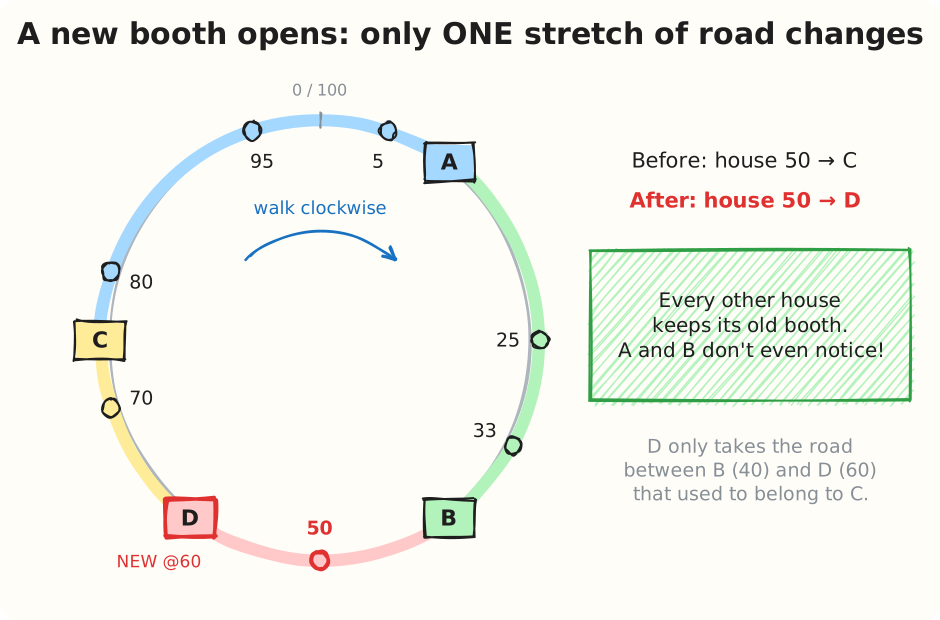
Look at the keys: - Key 5 still belongs to Server A. - Key 25 and 33 still belong to Server B. - Key 70 still belongs to Server C. - Keys 80 and 95 still belong to Server A. - Only Key 50 (which used to walk to Server C @ 75) now stops at Server D @ 60!
🏢 Daily Routine: Opening Counter D at Marker 60
To help with a festival rush, management opens Counter D at marker 60:
- Only residents between markers 41 and 60 (who previously walked all the way to Counter C at marker 75) now pick up parcels from the new Counter D.
- Residents visiting Counter A and Counter B are completely unaffected and continue as usual!
💻 In Software:
- Server D only takes over the arc \((40, 60]\) from Server C.
- Servers A and B are completely untouched.
- No global cache invalidation, no cache stampede!
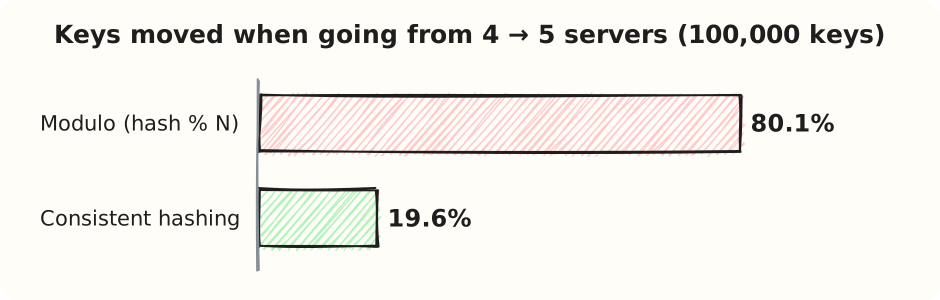
In our experiment with 100,000 keys: - Modulo hashing moved 80,100 keys (80.1%). - Consistent Hashing moved only 19,600 keys (19.6%), exactly matching the theoretical ideal \(\frac{1}{N+1} = \frac{1}{5} = 20\%\).
Step 6: Removing or Crashing a Server
What happens when Server B crashes or goes down for maintenance?
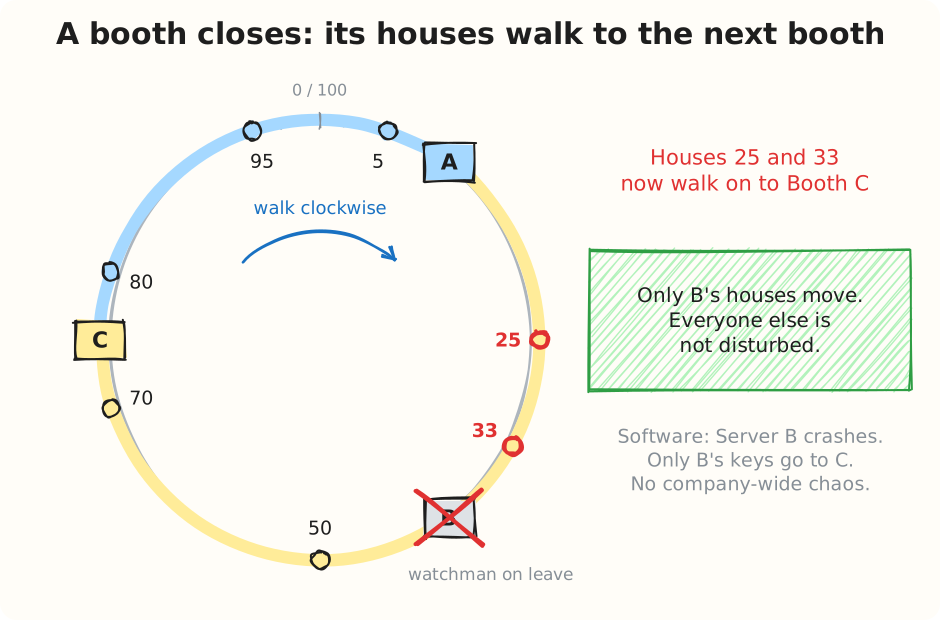
- Server B (position 40) disappears from the ring.
- Keys 25 and 33 now continue walking clockwise until they reach the next active node: Server C (or Server D if present).
- Keys belonging to Server A and Server C are completely unaffected.
🏢 Daily Routine: Counter B Closes for Maintenance
If Counter B (at marker 40) temporarily closes:
- Parcels intended for Counter B (markers 11 to 40) are simply carried clockwise to the next open desk: Counter C (at 75).
- Residents collecting parcels from Counter A and Counter C are completely unaffected. The entire building does not reshuffle!
Step 7: The Unfair Skew Problem (Hotspot Arcs)
So far, our simple ring looks brilliant. But in real life, basic consistent hashing has a major hidden flaw: random hash functions do not guarantee equal spacing.
Why does this happen?
When you want to divide work among 3 servers, you hope each server gets an equal \(33\%\) slice of the ring.
However, remember how server positions are decided: we pass their names through a hash function:
* hash("Server-A") might output position 10
* hash("Server-B") might output position 20
* hash("Server-C") might output position 90
A hash function treats server names like random lottery tickets. It does not know or care that you want them spaced evenly at \(0\), \(33\), and \(66\). As a result, two servers can accidentally land right next to each other, while a third server gets stuck with a giant chunk of the ring!
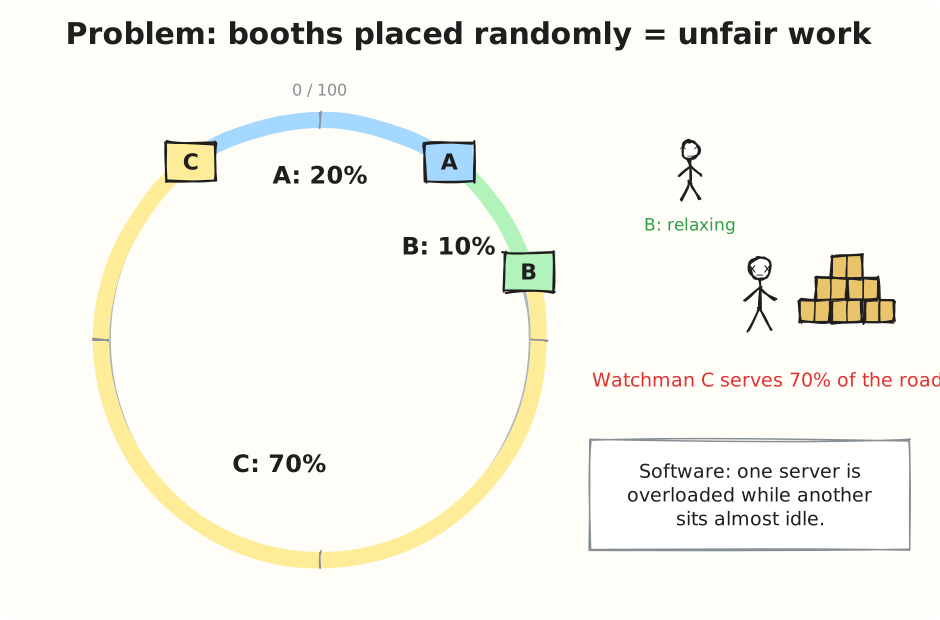
Look at what happens to the workload in the diagram above: - Server B sits at 20, right behind Server A (at 10). It only handles the tiny stretch from 11 to 20 (only 10% of the ring). - Server A sits at 10. It handles 91 to 10 (20% of the ring). - Server C sits at 90. Because nobody is placed between 21 and 90, Server C is forced to handle that entire massive arc (70% of the ring!).
🏢 Daily Routine: The Overworked Clerk
Imagine the 3 parcel counters are placed unevenly around the lobby: - Counter A is at marker 10 (handles flats 91–10: 20% of deliveries). - Counter B is at marker 20 (handles flats 11–20: only 10% of deliveries). The clerk at Counter B is relaxing with almost nothing to do! - Counter C is at marker 90 (handles flats 21–90: a massive 70% of deliveries!). The poor clerk at Counter C is buried under mountains of boxes, sweating and exhausted.
💻 Software Consequence: Cascading Server Crashes
- Server C receives 70% of all user traffic.
- Under heavy load, Server C runs out of memory or CPU and crashes.
- Now all of Server C's massive 70% load dumps onto the next server clockwise (Server A).
- Server A instantly gets overloaded and crashes too.
- This domino effect kills the entire cluster — a classic cascading failure.
Step 8: The Golden Fix — Virtual Nodes (Vnodes)
How do we force a random hash ring to be fair without manual placement? We use Virtual Nodes (introduced in Amazon's Dynamo paper).
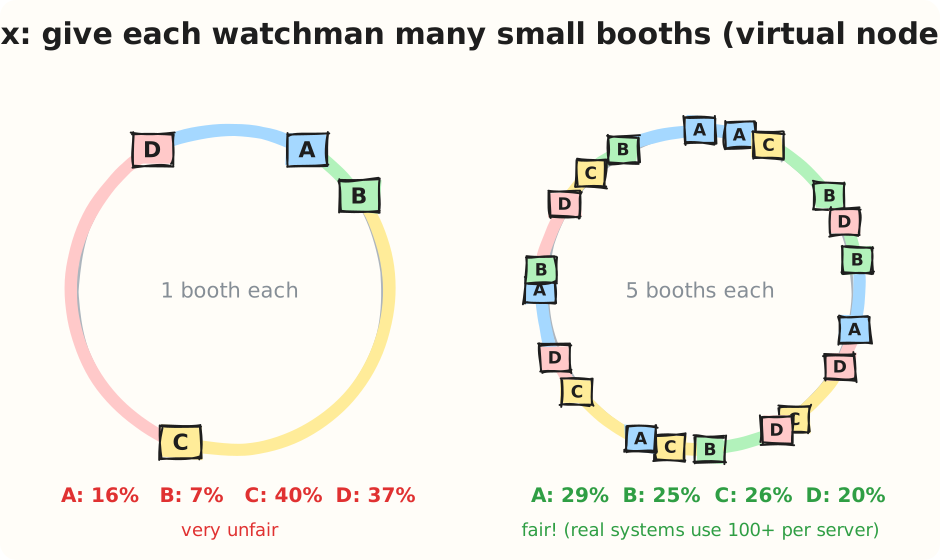
Instead of placing each physical server on the ring once, we map each physical server to many virtual points across the ring:
# Server A gets multiple virtual node labels:
hash("Server-A#0")  --> Position  8
hash("Server-A#1")  --> Position 47
hash("Server-A#2")  --> Position 83
...
All these virtual nodes route back to the same physical machine Server A.
🏢 Daily Routine: Multiple Parcel Shelves per Clerk
Instead of each clerk sitting at just one counter, management sets up 100 small parcel shelves scattered all around the circular lobby:
- Clerk A manages 25 random shelves (Shelf-A1, Shelf-A2...)
- Clerk B manages 25 random shelves (Shelf-B1, Shelf-B2...)
- Clerk C manages 25 random shelves (Shelf-C1, Shelf-C2...)
- Clerk D manages 25 random shelves (Shelf-D1, Shelf-D2...)
Because the shelves are interleaved and spread across the entire circle, incoming parcels naturally distribute with near-perfect fairness. No single clerk gets crushed under a mountain of boxes!
📊 Empirical Proof with 100,000 Real Keys:
Here is what happened in our actual benchmark when distributing 100,000 keys across 4 servers:
| Virtual Nodes per Server | Server A | Server B | Server C | Server D | Balance Quality |
|---|---|---|---|---|---|
| 1 vnode (No vnodes) | 3.0% (3,057) | 1.3% (1,332) | 40.2% (40,206) | 55.4% (55,405) | 🚨 Severe Outage Risk |
| 10 vnodes | 12.0% | 39.9% | 21.8% | 26.3% | ⚠️ Uneven |
| 100 vnodes | 25.7% | 24.8% | 25.2% | 24.3% | 🎯 Virtually Perfect |
Three Huge Production Superpowers of Vnodes:
- Even Failure Redistribution: When Server A dies, its 100 virtual slices are interspersed across the entire ring. Its traffic is evenly shared among Server B, C, and D — no single server gets crushed.
- Weighted Heterogeneous Hardware: Have an expensive 64-core server and a cheap 16-core server? Give the large server 400 vnodes and the small server 100 vnodes. The load automatically splits \(4:1\) without altering any logic!
- Smooth Gradual Rebalancing: When scaling up, a new machine gently takes tiny fractions from every existing node.
Step 9: High Availability via Replication
In any distributed database (like Apache Cassandra or Amazon DynamoDB), storing just one copy of your data is dangerous. What if the server's SSD fails?
🏢 Daily Routine: Duplicate Parcel Slips
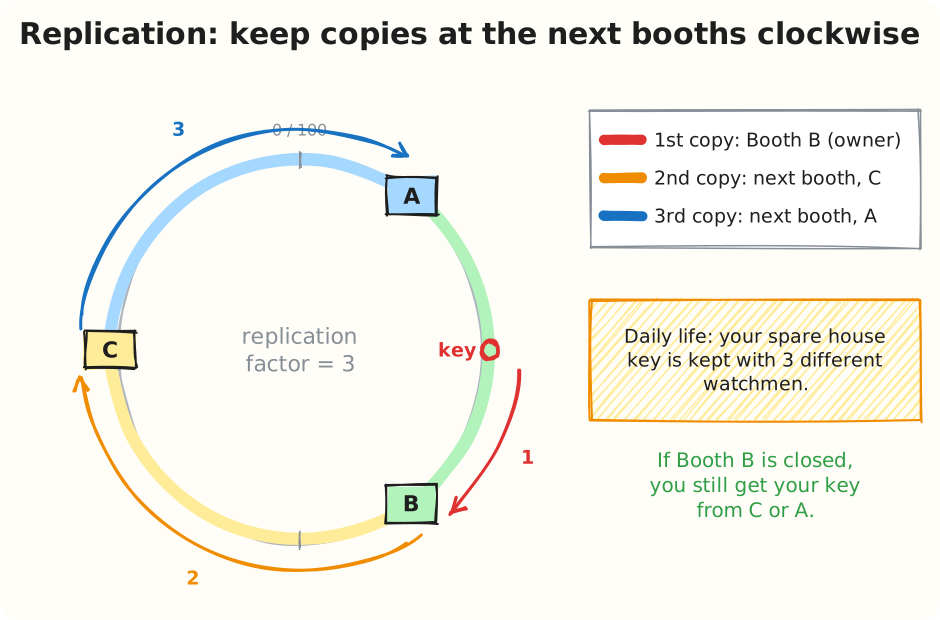
When an important delivery arrives, the watchman doesn't just log it at Counter A. He leaves duplicate pickup slips at neighboring Counters B and C. If Counter A's desk is temporarily closed, the resident can still collect their parcel from Counter B or C without waiting.
💻 In Software: Clockwise Walk with Replication Factor \((R)\)
In production databases (like Amazon DynamoDB or Apache Cassandra), we never store only one copy of data. If that computer's drive fails, your data is gone!
We configure a Replication Factor (commonly \(R = 3\), meaning 3 identical copies): 1. Find Primary Server: Hash the key to find its position on the ring, and walk clockwise to the first server (Server A). Save Copy 1 here. 2. Find Replicas: Continue walking clockwise along the ring to store Copy 2 on Server B, and Copy 3 on Server C.
Now, your data is safely backed up on 3 servers!
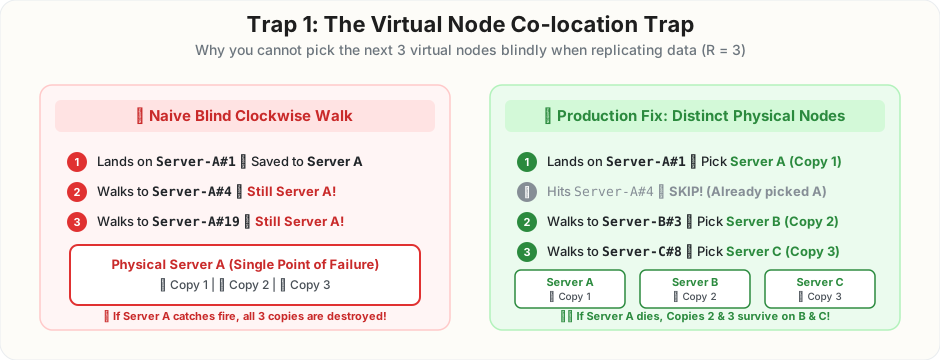
⚠️ Trap 1: The Virtual Node Co-location Trap
Remember from Step 8 that every physical server has hundreds of virtual nodes (vnodes) scattered across the ring (like Server-A#1, Server-A#2, Server-A#3...).
If you blindly walk clockwise to pick 3 replica points, you might hit:
1. Server-A#1 \(\rightarrow\) Copy 1 saved on Server A.
2. Server-A#4 \(\rightarrow\) Copy 2 saved... wait, this is still Server A!
3. Server-A#19 \(\rightarrow\) Copy 3 saved... this is also Server A!
🏢 In our Apartment Analogy:
Imagine Clerk A manages several shelves around the lobby (Shelf-A1, Shelf-A2, Shelf-A3). If the watchman places all 3 duplicate delivery slips into Shelf-A1, Shelf-A2, and Shelf-A3, all 3 slips still depend on Clerk A! If Clerk A calls in sick or spills water over his counter, all 3 slips are lost at once.
💻 The Software Fix:
When walking clockwise to place replicas, the algorithm checks the physical owner. If a virtual node belongs to a physical machine you already selected, skip it and keep walking until you find a completely different physical server (Server B, Server C).
⚠️ Trap 2: Rack & Availability Zone (AZ) Awareness
Even if you pick 3 distinct machines (Server A, Server B, and Server C), consider where they physically sit in a datacenter:
- In a real server room, servers are mounted inside tall metal cabinets called Racks.
- All servers in a rack share the same power cable, breaker, and top-of-rack network switch.
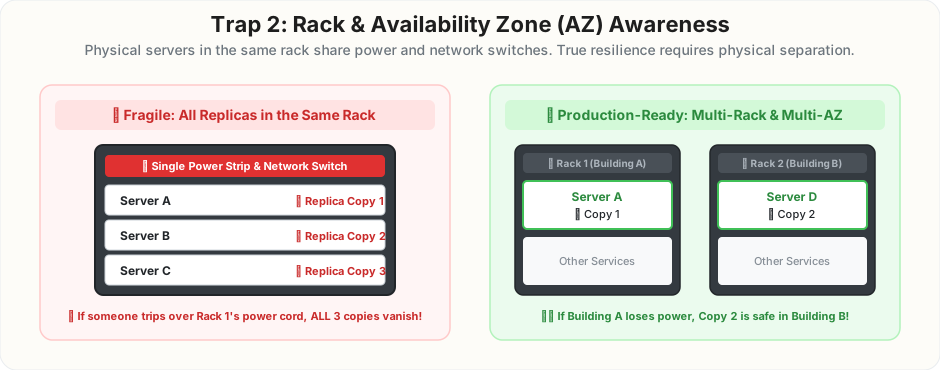
If Server A, B, and C are all plugged into Rack 1, what happens if someone trips over Rack 1's power cable, or Rack 1's power supply blows? All 3 copies go down together.
🛡️ The Production Fix:
Smart distributed databases enforce Rack and Availability Zone (AZ) Awareness: * Copy 1 is placed on Server A (in Rack 1). * Copy 2 is placed on a server in Rack 2 (separate power and network switch). * Copy 3 is placed in a completely separate building or power grid (an Availability Zone).
Even if a lightning strike knocks out an entire datacenter building, your data is safe and immediately accessible from the other building!
Part 3: Advanced Concepts & Production Realities
Step 10: How Ring Lookups Work at Nanosecond Speed
In our circular diagrams, we say "walk clockwise around the ring until you find a server".
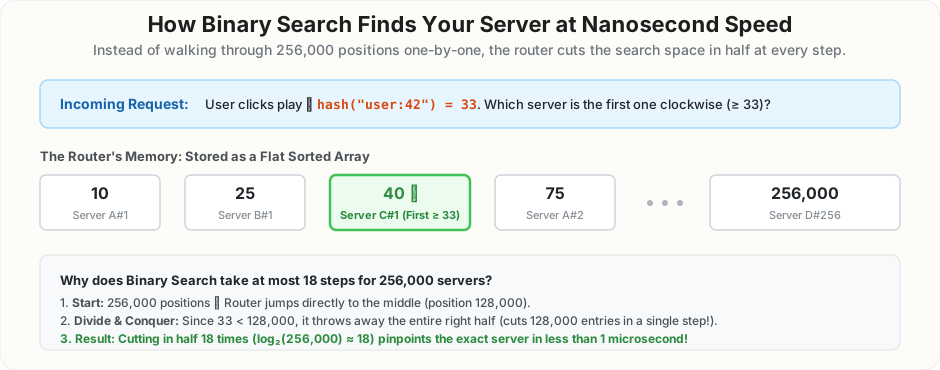
That is great for human imagination. But in a real cluster with 1,000 servers and 256 vnodes each, there are 256,000 server positions on the ring. If your software checked them one-by-one, lookups would crawl to a halt!
💻 In Software: Sorted Array + Binary Search (\(O(\log V)\))
The router does not draw a circle in memory. Instead, it stores all server positions in a flat, sorted array:
# Array of server positions kept strictly sorted:
server_positions = [10, 25, 40, 75, 110, ... 256000]
When a request arrives for user:42:
1. Calculate its hash coordinate: pos = hash("user:42") (suppose it equals 33).
2. The router needs to answer one question: "What is the first server position in this list that is \(\ge 33\)?"
3. Instead of checking 1 by 1 from the start, it runs Binary Search (bisect_right in Python / std::upper_bound in C++):
* It jumps straight to the middle of the 256,000 list.
* If 33 is smaller than the middle, it immediately throws away the entire right half (128,000 numbers eliminated in 1 step!).
* It repeats this, cutting the search area by \(50\%\) on every single comparison.
4. If \(pos\) is greater than the last server in the array, it simply wraps around to index 0.
🏢 Daily Routine: Flipping Through the Sorted Delivery Register
When looking up which counter holds a resident's parcel, the watchman doesn't read every entry from page 1. The delivery register is kept sorted by flat number. The watchman opens to the middle, sees Flat 500, flips back to find Flat 204 in seconds. That is binary search — \(O(\log V)\).
⏱️ Why is this so insanely fast?
Every step cuts the search space in half. For 256,000 virtual nodes, it takes at most 18 comparisons:
18 CPU comparisons take less than 0.000001 seconds (under 1 microsecond). That is why Consistent Hashing handles millions of requests per second effortlessly!
Step 11: Production-Ready Python Implementation (Optional LLD / Deep-Dive)
[!NOTE] Interview Context: High-Level (HLD) vs Low-Level (LLD) * In a High-Level System Design (HLD) interview: You will never be asked to write 100 lines of working Python code. Interviewers only expect you to explain the concepts on a whiteboard (virtual nodes, replica placement, and \(O(\log V)\) binary search lookups). * In a Low-Level Design (LLD) / Machine Coding interview: Companies like Stripe, Uber, or Google occasionally ask candidates to implement an in-memory consistent hash router with
add_node(),remove_node(), andget_node().Feel free to skip this section if you are preparing exclusively for System Architecture / HLD interviews!
🔍 Click to expand the complete Python implementation & test harness
Here is a tested, production-grade implementation of a Consistent Hash Ring with virtual nodes, $O(\log V)$ binary search, and deduplicated physical replication:
"""
production_consistent_hashing.py
A complete, self-contained implementation of a Consistent Hash Ring with:
- Configurable virtual nodes
- Fast O(log V) lookups using binary search
- Deduplicated replica allocation for high availability
- Support for weighted physical nodes
"""

import bisect
import hashlib
from typing import Dict, List, Set


class ConsistentHashRing:
    def __init__(self, default_vnodes: int = 100):
        self.default_vnodes = default_vnodes
        self._sorted_keys: List[int] = []            # Sorted ring coordinates
        self._ring: Dict[int, str] = {}               # Coordinate -> Physical Node ID
        self._nodes: Set[str] = set()                # Set of registered physical nodes

    def _hash(self, val: str) -> int:
        """
        MD5 provides excellent uniform bit distribution for ring placement.
        In latency-critical C++ systems, xxHash or Murmur3 is commonly used.
        """
        return int(hashlib.md5(val.encode("utf-8")).hexdigest(), 16)

    def add_node(self, node: str, weight: int = 1) -> None:
        """
        Add a physical node with an optional capacity weight multiplier.
        """
        if node in self._nodes:
            return
        self._nodes.add(node)
        num_vnodes = self.default_vnodes * max(1, weight)

        for i in range(num_vnodes):
            vnode_key = f"{node}#vnode-{i}"
            pos = self._hash(vnode_key)
            self._ring[pos] = node
            bisect.insort(self._sorted_keys, pos)

    def remove_node(self, node: str) -> None:
        """
        Gracefully decommission or remove a failed physical node.
        """
        if node not in self._nodes:
            return
        self._nodes.remove(node)

        # Remove all virtual nodes belonging to this physical machine
        new_sorted_keys = []
        for pos in self._sorted_keys:
            if self._ring.get(pos) == node:
                del self._ring[pos]
            else:
                new_sorted_keys.append(pos)
        self._sorted_keys = new_sorted_keys

    def get_node(self, key: str) -> str:
        """
        Route a key to its primary coordinator node in O(log V) time.
        """
        if not self._ring:
            raise RuntimeError("Consistent hash ring is empty!")

        pos = self._hash(key)
        idx = bisect.bisect_right(self._sorted_keys, pos)

        # Wrap around to the start of the ring if we exceed the highest token
        if idx == len(self._sorted_keys):
            idx = 0

        return self._ring[self._sorted_keys[idx]]

    def get_replicas(self, key: str, count: int = 3) -> List[str]:
        """
        Return `count` DISTINCT physical nodes for replica placement.
        Skips co-located virtual nodes automatically.
        """
        if not self._ring:
            raise RuntimeError("Consistent hash ring is empty!")

        total_physical = len(self._nodes)
        desired_replicas = min(count, total_physical)
        selected_nodes: List[str] = []
        seen_physical: Set[str] = set()

        pos = self._hash(key)
        idx = bisect.bisect_right(self._sorted_keys, pos)
        ring_len = len(self._sorted_keys)

        # Walk clockwise until we gather the required distinct physical nodes
        step = 0
        while len(selected_nodes) < desired_replicas and step < ring_len:
            curr_pos = self._sorted_keys[(idx + step) % ring_len]
            physical_node = self._ring[curr_pos]

            if physical_node not in seen_physical:
                seen_physical.add(physical_node)
                selected_nodes.append(physical_node)
            step += 1

        return selected_nodes
from collections import Counter

# 1. Initialize cluster with 4 servers and 100 virtual nodes each
cluster = ConsistentHashRing(default_vnodes=100)
for s in ["Server-A", "Server-B", "Server-C", "Server-D"]:
    cluster.add_node(s)

# 2. Simulate 100,000 real user session keys
keys = [f"session:user-{i}" for i in range(100_000)]
initial_mapping = {k: cluster.get_node(k) for k in keys}

print("Load Distribution Across 4 Nodes:")
for node, count in sorted(Counter(initial_mapping.values()).items()):
    print(f"  {node}: {count:,} keys ({count/len(keys):.2%})")

# 3. Scale out by adding Server-E
cluster.add_node("Server-E")
scaled_mapping = {k: cluster.get_node(k) for k in keys}

# 4. Measure key movement
moved_keys = sum(1 for k in keys if initial_mapping[k] != scaled_mapping[k])
print(f"\nKeys moved after adding Server-E: {moved_keys:,} ({moved_keys/len(keys):.2%})")
print("Ideal theoretical movement: 20.00%")

# 5. Check replication set for a user key
replicas = cluster.get_replicas("session:user-999", count=3)
print(f"\nReplication Set for user-999: {replicas}")
Load Distribution Across 4 Nodes:
  Server-A: 25,720 keys (25.72%)
  Server-B: 24,845 keys (24.85%)
  Server-C: 25,154 keys (25.15%)
  Server-D: 24,281 keys (24.28%)

Keys moved after adding Server-E: 19,634 (19.63%)
Ideal theoretical movement: 20.00%

Replication Set for user-999: ['Server-B', 'Server-E', 'Server-A']
Step 12: Advanced Production Challenges & Remedies
12.1 The Celebrity Hotspot Problem (Hot Keys)
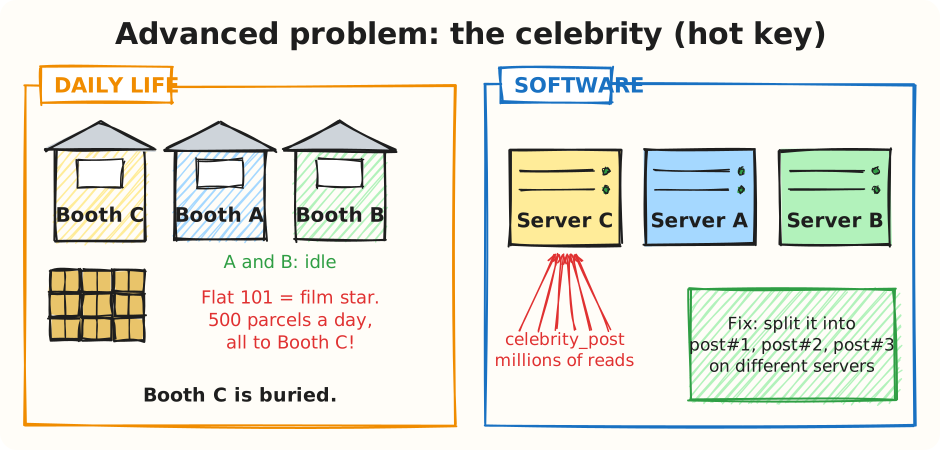
There is a fundamental difference between storage balance and traffic balance: * Virtual nodes ensure that each server gets roughly the same number of keys (e.g., 25,000 keys on each of 4 servers). * Virtual nodes CANNOT ensure that each key gets the same amount of traffic!
What happens if 24,999 keys get only 1 visit per day, but 1 single key (item:iphone-16-pro or @taylorswift) gets 5,000,000 requests per second?
Because hash("item:iphone-16-pro") always maps to the exact same ring coordinate, 100% of those 5 million requests will hit the exact same server (Server C). Server C's CPU hits 100% and crashes, while Servers A, B, and D sit completely idle!
🏢 In our Apartment Analogy:
Imagine Flat 101 belongs to a famous movie star. On their birthday, 10,000 gift boxes and flower bouquets arrive in a single afternoon.
Even though the watchman divided the building's 1,000 flats evenly across 4 counters (250 flats per counter), Flat 101 belongs to Counter C. Poor Clerk C is buried alive under 10,000 parcels with angry delivery drivers shouting, while Clerks A, B, and D are sitting back drinking tea with nothing to do!
🛠️ How Production Systems Solve This:
- Key Salting (Splitting 1 Hot Key into Multiple Keys):
- Instead of saving the product under a single key
item:iphone-16, the backend writes it under multiple "salted" keys:item:iphone-16#1,item:iphone-16#2,item:iphone-16#3, ...item:iphone-16#10. - Because each sub-key has a different name, the hash function places them at different locations around the ring, spreading them across Server A, Server B, Server C, and Server D.
- When an app user views the iPhone page, the client randomly picks a number between 1 and 10:
read("item:iphone-16#" + random(1, 10)). - Result: The 5 million requests are evenly divided across all servers instead of crushing one!
-
In the apartment: The watchman tells fans to write a sub-box on the label:
Flat 101-A,Flat 101-B, etc. The couriers are distributed across all 4 counters. -
Local In-Memory Cache (Near-Cache):
- Why send requests to the database or cache cluster at all?
- When the API Gateway (the router) detects that
item:iphone-16is getting 50,000 requests/sec, it stores a copy directly inside its own local RAM for just 3 to 5 seconds. -
Incoming requests are answered immediately at the gateway in 0.1 milliseconds without touching backend servers!
-
Read from Any Replica:
- In Step 9, we configured Replication (\(R=3\)), so identical copies already live on Server C, Server D, and Server A.
- Instead of sending all read requests to the primary coordinator (Server C), the router randomly divides reads across all 3 replica machines.
12.2 Google's Consistent Hashing with Bounded Loads
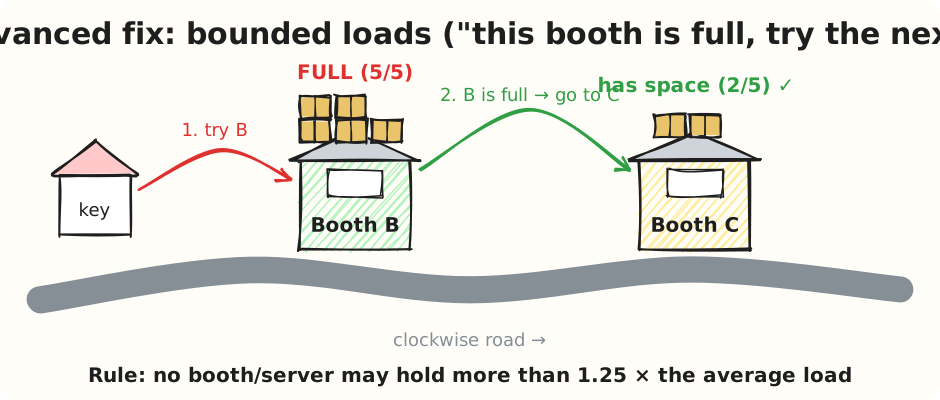
Standard consistent hashing has one blind spot: it is stubborn. If a request hashes to Server C's coordinate, the router must send it to Server C—even if Server C is currently overloaded and screaming for help!
In 2017, Google Research published a brilliant enhancement: Consistent Hashing with Bounded Loads (Mirrokni et al.).
💡 The Core Idea:
Set a maximum capacity cap on each server. If your assigned server is at its limit, spill over clockwise to the next server on the ring!
🔢 How the Math Works (Simple Example):
Suppose your cluster has 4 servers (A, B, C, D) and is currently handling 400 active requests:
-
Calculate the Average Load: $\(\text{Average Load} = \frac{400 \text{ requests}}{4 \text{ servers}} = 100 \text{ requests per server}\)$
-
Set the Maximum Cap (\(1.25\times\) or \(25\%\) above average): $\(\text{Max Allowed Load} = 1.25 \times 100 = 125 \text{ requests}\)$ (No individual server is allowed to hold more than 125 active requests!)
-
Routing with Spillover:
- A new request arrives for
user:99. - The ring says: "Send this request to Server C."
- The router checks: Server C already has 125 active requests (it is 100% full).
- Instead of crashing Server C with request #126, the router walks clockwise to the next server (Server D).
- Server D only has 75 requests. Server D handles the request!
🏢 In our Apartment Analogy:
The building manager gives the lobby watchman a simple safety rule:
"No counter is allowed to have a line longer than 1.25× the average queue. If the average line across the lobby is 8 residents, no counter may have more than 10 people waiting."
When a resident arrives for Counter C, the watchman sees Counter C already has 10 people in line. The watchman says:
"Counter C is full right now. Please walk 5 steps clockwise to Counter D right next to it—their clerk has no line!"
🚀 Why this is so powerful in production:
- Over 95% of requests still go to their primary server (preserving cache hit rates).
- Zero server crashes: No single server can ever be hit with more than \(1.25\times\) average load.
- Industry adoption: This exact algorithm is built directly into Envoy Proxy and powers Vimeo's video streaming load balancers.
12.3 Ring Hashing vs. Alternative Algorithms
Consistent Hashing with rings and vnodes is the industry standard, but modern systems have explored alternatives:
| Algorithm | How It Works | Strengths | Tradeoffs | Used By |
|---|---|---|---|---|
| Ring Hashing + Vnodes (Karger et al. 1997) | Circular hash space; binary search to nearest clockwise node | Supports weights, simple replication, dynamic membership | \(O(V)\) memory for ring; \(O(\log V)\) lookup | Cassandra, DynamoDB, Memcached |
| Rendezvous Hashing (HRW) (Thaler & Ravishankar 1996) | For key \(K\) and node \(S\), compute \(H(K, S)\); pick node with highest score | Zero memory overhead, minimal key movement | \(O(N)\) lookup time (computes hash for every server) | GitHub load balancers, BitTorrent DHT |
| Jump Consistent Hash (Google, Lamping & Veach 2014) | Fast mathematical loop generates bucket index in 10 lines of code | Zero memory, ultra-fast \(O(\ln N)\), perfect balance | Nodes must be numbered \(0 \dots N-1\); cannot remove middle nodes | Google internal, distributed storage |
| Maglev Hashing (Google 2016) | Precomputes a large lookup table using permutation arrays | \(O(1)\) lookup time, near-perfect load balance | Rebuilding lookup table takes time during membership changes | Google Maglev network load balancers, Envoy |
Part 4: Real-World Systems & Interview Mastery
Step 13: Where Is Consistent Hashing Used in the Real World?
- Apache Cassandra & ScyllaDB: Uses a circular token ring (Murmur3Partitioner) with virtual nodes (tokens). Nodes discover ring membership changes automatically via a Gossip Protocol.
- Amazon Dynamo & DynamoDB Architecture: Uses consistent hashing with vnodes and sloppy quorums with hinted handoff for resilient masterless writes.
- Discord Voice & Guild Architecture: Discord runs millions of concurrent voice rooms on Elixir processes. Consistent hashing routes guild channels to specific Erlang VM nodes, keeping communication low-latency.
- Content Delivery Networks (Akamai, Cloudflare): The original 1997 MIT academic paper by David Karger and team was written specifically to solve web cache bottlenecks on the early internet — which directly led to the founding of Akamai.
- Distributed LLM Inference (vLLM, SGLang, Prefix Caching): When multiple GPU servers serve Large Language Models, storing the KV Cache (Key-Value cache) in GPU VRAM is critical. Consistent hashing routes prompts sharing identical system prefixes to the same GPU worker, avoiding redundant token prefill computation and speeding up inference by 3x–5x!
Step 14: System Design Interview Blueprint
If an interviewer asks:
"Design a Distributed Cache like Redis Cluster" or "How would you shard user data across 50 database nodes?"
Follow this 5-stage blueprint:
  ┌───────────────────────────────────────────────────────────────────────────┐
  │                 INTERVIEW BLUEPRINT: CONSISTENT HASHING                   │
  ├───────────────────────────────────────────────────────────────────────────┤
  │ 1. Clarify the Bottleneck:                                                │
  │    "Simple modulo hashing (hash(key) % N) causes ~N/(N+1) data migration  │
  │    when scaling. We need minimal reassignment to prevent cache stampedes."│
  │                                                                           │
  │ 2. Propose the Hash Ring:                                                 │
  │    "Map both servers and keys onto a 2^32 - 1 ring using MD5/Murmur3.    │
  │    Traverse clockwise using binary search in O(log V) time."              │
  │                                                                           │
  │ 3. Address Non-Uniformity (Virtual Nodes):                                │
  │    "Plain rings create hot spots. Introduce 100-256 virtual nodes per     │
  │    physical server to equalize load and reflect hardware weights."        │
  │                                                                           │
  │ 4. Introduce Replication & Failure Domains:                               │
  │    "Store replicas on the next R distinct physical servers clockwise,    │
  │    skipping co-located virtual nodes. Enforce multi-AZ rack isolation."   │
  │                                                                           │
  │ 5. Flex Advanced Edge Cases:                                              │
  │    "Mitigate celebrity keys via salting/local caching, and apply Google's │
  │    Bounded Loads to cap maximum server utilization at 1.25x average."     │
  └───────────────────────────────────────────────────────────────────────────┘
Summary Cheat Sheet
| Topic | Key Takeaway | Apartment Parcel Counter Analogy |
|---|---|---|
| Sharding | Dividing data across multiple machines | Opening multiple parcel collection counters |
| Modulo Hashing (% N) | Fails catastrophically on cluster resize (\(80\%+\) keys move) | Re-numbering every parcel counter in the building when 1 desk is added |
| Hash Ring | Ring where keys route to the nearest clockwise server | Circular lobby where parcels route to the nearest clockwise counter |
| Adding a Node | Only takes keys from its immediate clockwise neighbor (\(\frac{1}{N+1}\)) | Opening Counter D only takes parcels from that single stretch of flats |
| Virtual Nodes | Multiple ring tokens per machine to prevent load skew | Giving each clerk 25 small parcel shelves around the lobby |
| Replication | Replicating data to \(R\) distinct physical machines clockwise | Keeping duplicate delivery logs at neighboring parcel counters |
| Hot Keys | Celebrity traffic overloading one node; mitigated via salting | A celebrity resident getting 10,000 parcels on their birthday |
| Google Bounded Loads | Dynamically pushes overflow traffic to next node (\(1.25\times\) cap) | Overloaded clerk sending excess boxes to the neighboring counter |