From Prompt Engineering to Context Engineering & Structured Outputs
How to organize everything a language model sees before it speaks, and how grammar masks force it to return clean, parseable data that never crashes your backend code
Why "Please Return Only Valid JSON" Crashes in Production
In Chapter 3 (Sampling Parameters), we saw how setting temperature = 0.0 forces a language model to pick the single highest-scoring token at every step. On paper, greedy decoding looks like everything you need to turn a conversational model into a deterministic backend microservice.
Suppose you are building an automated order-support backend for an e-commerce customer named Alex (usr_alex). When Alex submits a support ticket saying "My mechanical keyboard from order ORD-8821 arrived with a cracked keycap, can I get a replacement or refund?", your Python backend needs to extract three fields so it can call your fulfillment database: the requested action ("refund" or "exchange"), the order identifier ("ORD-8821"), and the item name ("mechanical keyboard").
To bridge the model's text output with your Python code, you ask the model to reply in JSON (JavaScript Object Notation, a standard text format that represents structured data as key-value pairs inside curly braces like {"action": "refund"}). You set temperature = 0.0 and write a classic 2023-style prompt:
You are a helpful customer support assistant.
Analyze the user's message and return ONLY valid JSON with keys "action", "order_id", and "item".
Do not include any extra text or markdown formatting.
User (usr_alex): My mechanical keyboard from order ORD-8821 arrived with a cracked keycap...
During your first fifty local tests, the model returns clean JSON and json.loads() parses it without complaint. Then you deploy the endpoint to production. Within an hour, 4% of incoming requests fail with json.decoder.JSONDecodeError: Expecting value: line 1 column 1 (char 0).
When you inspect the failing payloads in your logs, you find three recurring patterns. First, when a frustrated customer writes a long, emotional message, the model's conversational training overrides your formatting instruction and it replies: Sure, I can help usr_alex with that: {"action": "refund", "order_id": "ORD-8821"}. That leading "Sure" character crashes json.loads() at column 1. Second, the model occasionally wraps the payload inside Markdown code fences (```json ... ```). Third, even when the syntax is valid JSON, the model invents keys you never asked for ("orderNumber" instead of "order_id") or invents enum values your database does not recognize ("action": "send_new_keyboard").
Trying to fix this by typing ALL-CAPS threats into the prompt ("CRITICAL: DO NOT SAY SURE, YOU WILL BE PENALIZED IF YOU OUTPUT MARKDOWN") is a brittle practice known as prompt hacking. Language models are trained via Reinforcement Learning from Human Feedback (RLHF) to be polite, chatty conversationalists. A polite conversational sentence has a high logit score in the model's weights, and English instructions inside a prompt only nudge those scores; they never mathematically forbid a token from being sampled.
To build reliable software on top of a language model, modern engineering teams replace prompt hacking with two concrete systems: Context Engineering on the input side, and Structured Outputs (Constrained Decoding) on the output side.
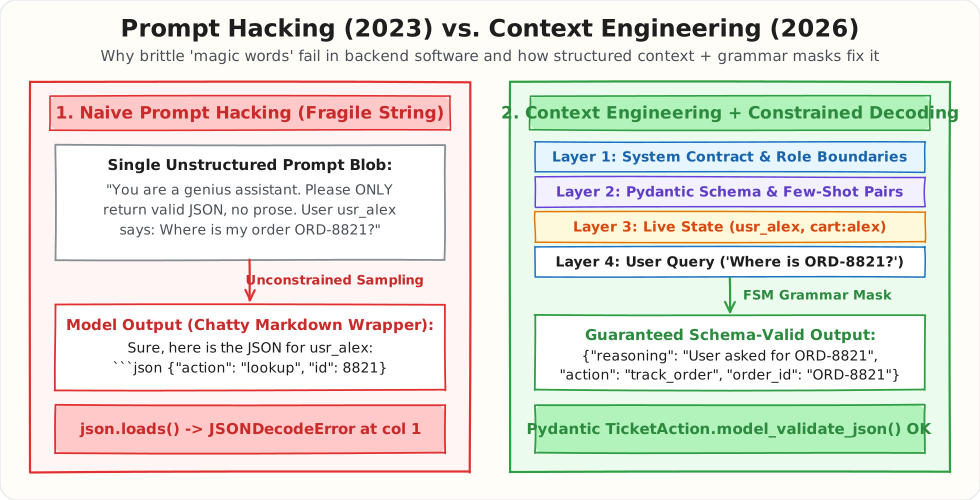
[!NOTE] Short Answer (30-Second Summary) Context Engineering is the discipline of structuring and ordering the entire token payload inside the model's context window (system rules, output schemas, few-shot examples, live database state for
usr_alex, and the current user message) so the model has the exact information it needs while maximizing GPU cache hits.Structured Outputs (Constrained Decoding) guarantees 100% valid JSON or
Pydanticschema compliance not by begging the model in English, but by compiling your target schema into a grammar state machine. At every single token generation step, the inference engine checks which characters are legally allowed next in your schema and masks the raw logits of all other vocabulary tokens to \(-\infty\) (0% probability) before sampling runs.
How Context Engineering and Constrained Decoding Work Under the Hood
Think of the difference between prompt hacking and context engineering + constrained decoding like filing a tax return. Prompt hacking is handing someone a blank sheet of paper, whispering five verbal instructions, and hoping they write their numbers in the exact boxes your optical scanner expects. Context engineering combined with constrained decoding is putting the user inside a digital web form where their prior-year W-2 data is pre-populated, dropdown menus only allow valid filing statuses, and letter keys are physically disabled inside numeric boxes.
1. The 5-Layer Context Stack (And Why Layer Order Controls Your Cloud Bill)
In 2023, developers treated a prompt as a single formatted string where system rules, user metadata, and retrieved database rows were concatenated with Python f-strings in whatever order felt convenient. In 2026, assembling a model request is treated like laying out memory segments in a compiler.
Every token you send into an LLM goes through the Prefill Phase, where the GPU computes attention Key (\(K\)) and Value (\(V\)) vectors for every input token across all Transformer layers and stores them in GPU memory inside the KV Cache (Key-Value Cache, a memory buffer that stores pre-computed attention vectors so the GPU does not have to re-read earlier words from scratch).
Modern LLM providers (OpenAI, Anthropic, Google Gemini) and open-weight serving engines (vLLM, SGLang) use Prefix Caching. When a new request arrives, the server hashes the input tokens from the beginning of the prompt. As long as the leading sequence of tokens is 100% identical to a previous request, the GPU reuses the cached \(K\) and \(V\) tensors directly from memory, cutting input token costs by 75% to 90% and reducing prefill latency by more than half. The moment a single token differs, prefix matching stops and every token after that point must be recomputed on the GPU.
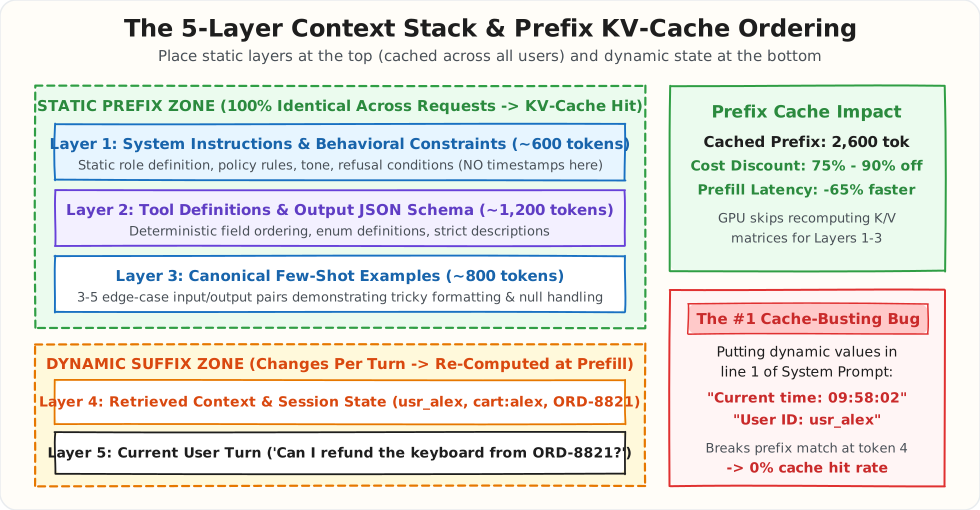
Because prefix caching matches strictly from top to bottom, a production Context Stack is divided into five layers ordered from the least frequently changing content at the top to the most frequently changing content at the bottom.
- Layer 1 holds the static system instructions and behavioral contract, defining the assistant's role, domain boundaries, refusal policies, and tone without any dynamic strings like
current_timestamporusr_alex. - Layer 2 holds the static tool and output schema definitions, keeping field ordering deterministic so the serialized JSON Schema token sequence never shifts between deploys.
- Layer 3 provides two to five canonical few-shot examples demonstrating how the system handles edge cases, ambiguous wording, and
nullfields. Together, Layers 1 through 3 form the Static Prefix Zone (typically 2,000 to 4,000 tokens) that remains identical across every user request. - Layer 4 injects the dynamic retrieved state and session memory fetched just before the call, such as Alex's account record (
usr_alex), active shopping cart (cart:alex), and recent order history (ORD-8821). - Layer 5 sits at the very bottom and contains the raw user message Alex just typed into the interface.
Look at what happens on the right side of the diagram if an engineer puts "Current Time: 2026-11-03 09:58:02 | User: usr_alex" on the very first line of Layer 1. Because the timestamp changes every second and the user ID changes on every customer, token #4 of the prompt is different on every API call. That single misplaced line invalidates the entire 2,600-token prefix cache, forcing you to pay full price and full GPU compute for Layers 1, 2, and 3 on 100% of your traffic.
2. How Constrained Decoding Enforces Schemas at Stage 1.5
Structuring the input context gives the model clear instructions and examples, but it still does not mathematically stop the model from emitting "Sure" as its first token. That guarantee comes from Constrained Decoding (also exposed as response_format or response_schema in LLM APIs, and powered by libraries like Outlines, XGrammar, and guidance in open-weight engines).
Under the hood, constrained decoding relies on two classic compiler concepts: a Finite-State Machine (FSM) and a Context-Free Grammar (CFG). A Finite-State Machine is a step-by-step blueprint consisting of a fixed number of states and legal transitions between them, much like a subway turnstile where pushing the bar in the locked state does nothing, inserting a ticket transitions it to the unlocked state, and walking through resets it back to locked. A Context-Free Grammar extends that blueprint with recursive rules that track nested structures, ensuring every opening curly brace { or bracket [ in a nested JSON object eventually gets a matching closing } or ].
When you pass a Pydantic model or JSON Schema into an inference engine, the engine compiles that schema into a state machine before generation starts. Each state in the machine corresponds to a specific position inside your JSON structure and maintains a precomputed bitmask of which token IDs in the 200,000-word vocabulary are valid continuations from that exact character position.
Recall the Classic 6-Stage Sampling Pipeline from Chapter 3 (Logits -> Penalties -> Temperature -> Top-K -> Softmax/Top-P -> Renormalize). Constrained decoding inserts a new Stage 1.5 (FSM Token Mask) right after Stage 1 (Raw Logits):
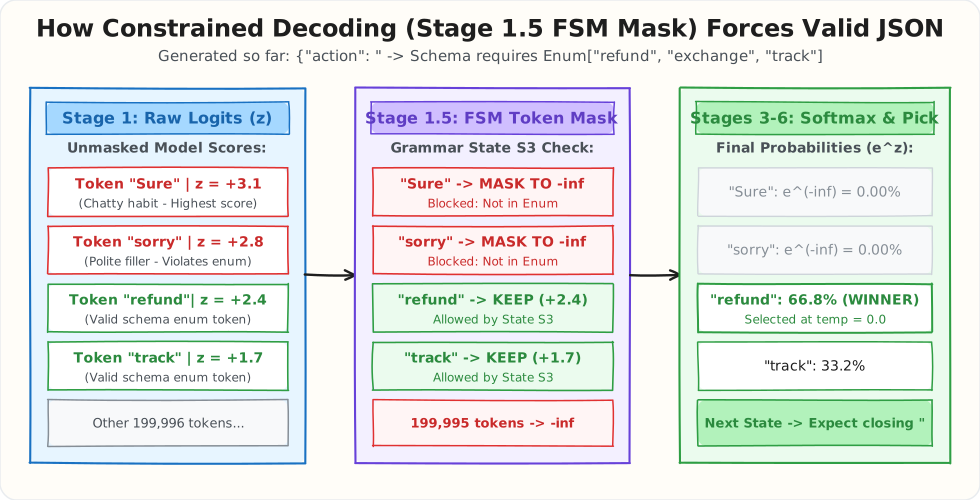
Let's trace what happens step by step when Alex's support ticket is processed against a schema where "action" must be one of "refund", "exchange", or "track":
- Suppose the engine has already generated the opening tokens
{"action": ". The grammar state machine is now sitting in State S3, where the only legal continuations are the enum strings"refund","exchange", or"track". - In Stage 1, the Transformer finishes its forward pass and outputs raw logits (\(z\)) across all 200,000 tokens. Because the model was trained on conversational chat, polite filler tokens still score high:
"Sure"gets +3.1,"sorry"gets +2.8,"refund"gets +2.4, and"track"gets +1.7. If we ran standard greedy decoding right now,"Sure"(+3.1) would win and corrupt the JSON value. - In Stage 1.5, the engine looks up the allowed token bitmask for State S3 and applies a hard mathematical rule to every token \(i\) in the vocabulary:
Because "Sure" (+3.1) and "sorry" (+2.8) are not in the enum list, their logits are overwritten with \(-\infty\) (represented in GPU floating-point math as -1e10 or -inf). Only "refund" (+2.4), "exchange" (+0.9), and "track" (+1.7) keep their raw scores.
4. In Stages 3 through 6, when the Softmax function exponentiates the masked logits, every illegal token evaluates to \(e^{-\infty} = 0.0000\%\). The surviving enum tokens are renormalized against each other: \(e^{2.4} \approx 11.02\) and \(e^{1.7} \approx 5.47\), giving "refund" roughly 66.8% probability and "track" 33.2%. At temperature = 0.0, "refund" wins cleanly.
5. Emitting "refund" advances the state machine to State S4, where the only legal next token in the entire 200,000-word vocabulary is the closing quote and comma (",).
[!TIP] Subword Token Healing Inside Grammar Masks As we learned in Chapter 2, tokenizers chop text into arbitrary subword pieces. A single token ID 14822 might represent the three characters
": "(a closing quote, a colon, and a space) all fused together. Modern grammar engines likeXGrammarandOutlinespre-index the entire tokenizer vocabulary against the state machine so a single multi-character token can advance the state machine across three grammar states in one step, while tokens that start with a space (" refund") are masked out when an unspaced quote just opened (").
Building a Prefix-Cached Context Compiler and FSM Mask in Python
Let's walk through a concrete implementation for Alex (usr_alex) that demonstrates both halves of the architecture: first, simulating the Stage 1.5 FSM logit mask in NumPy so you can see the exact math on raw logits, and second, structuring a production Pydantic schema with prefix-ordered context layers.
1. Simulating the Stage 1.5 FSM Logit Mask in NumPy
import numpy as np

# Vocabulary snapshot at generation step: '{"action": "'
vocab = ["Sure", "sorry", "refund", "track", "exchange", "```json"]
raw_logits = np.array([3.1, 2.8, 2.4, 1.7, 0.9, 2.5], dtype=np.float64)

# State S3 in our FSM only permits valid Enum tokens for the "action" field
allowed_enum_tokens = {"refund", "track", "exchange"}


def constrained_decode_step(
    tokens: list[str], logits: np.ndarray, valid_set: set[str], temperature: float = 0.0
) -> tuple[str, dict[str, float]]:
    # Stage 1.5: Build boolean mask from FSM state and set illegal logits to -infinity
    fsm_mask = np.array([tok in valid_set for tok in tokens])
    masked_logits = np.where(fsm_mask, logits, -np.inf)

    if temperature == 0.0:
        winner_idx = int(np.argmax(masked_logits))
        probs = np.zeros_like(masked_logits)
        probs[winner_idx] = 1.0
    else:
        scaled = masked_logits / temperature
        # Subtract max finite value for numerical stability before exp()
        shifted = scaled - np.max(scaled[np.isfinite(scaled)])
        exp_scores = np.exp(shifted)
        probs = exp_scores / np.sum(exp_scores)
        winner_idx = int(np.argmax(probs))

    dist = {tok: round(float(p) * 100, 2) for tok, p in zip(tokens, probs)}
    return tokens[winner_idx], dist


winner_unconstrained = vocab[int(np.argmax(raw_logits))]
winner_constrained, prob_table = constrained_decode_step(
    vocab, raw_logits, allowed_enum_tokens, temperature=1.0
)

print(f"Unconstrained Greedy Winner : {winner_unconstrained!r} (logit +3.1 -> breaks JSON)")
print(f"Constrained FSM Winner      : {winner_constrained!r}")
print(f"Renormalized Probabilities  : {prob_table}")
Running this script prints the exact mathematical shift between unconstrained sampling and FSM-masked sampling:
Unconstrained Greedy Winner : 'Sure' (logit +3.1 -> breaks JSON)
Constrained FSM Winner      : 'refund'
Renormalized Probabilities  : {'Sure': 0.0, 'sorry': 0.0, 'refund': 59.35, 'track': 29.47, 'exchange': 11.18, '```json': 0.0}
2. Defining the Context Stack and Pydantic Schema for usr_alex
In application code, you do not build token bitmasks by hand. Instead, you define a strict Pydantic schema and assemble the 5-layer context so the static system contract, schema, and few-shot examples stay locked at the top of the message array:
from enum import Enum
from typing import Optional
from pydantic import BaseModel, Field


class SupportAction(str, Enum):
    REFUND = "refund"
    EXCHANGE = "exchange"
    TRACK_ORDER = "track_order"
    ESCALATE_HUMAN = "escalate_human"


class SupportTicketDecision(BaseModel):
    # Reasoning field is placed FIRST so the model works through the facts before picking an enum
    reasoning_steps: list[str] = Field(
        description="Step-by-step verification of user identity, order status, and policy eligibility."
    )
    action: SupportAction = Field(
        description="The exact fulfillment action to trigger in the order database."
    )
    order_id: Optional[str] = Field(
        default=None,
        description="Order identifier matching ORD-XXXX if present in the message or session; null otherwise.",
    )
    item_sku: Optional[str] = Field(
        default=None,
        description="Specific item SKU from the order if identified; null otherwise.",
    )


def compile_support_context(user_id: str, cart_key: str, active_orders: list[dict], user_message: str) -> list[dict]:
    # Layers 1-3: Static Prefix (100% identical across all users -> hits Prefix KV Cache)
    static_system_prefix = (
        "ROLE: Deterministic Order Support Router.\n"
        "RULES:\n"
        "1. Verify that any referenced order_id exists in the user's ACTIVE_ORDERS list.\n"
        "2. Damaged physical items reported within 30 days qualify for 'refund' or 'exchange'.\n"
        "3. If no order_id is mentioned and cannot be inferred from ACTIVE_ORDERS, set order_id to null.\n\n"
        "FEW-SHOT EXAMPLES:\n"
        "Input: [User: usr_alex | Orders: ORD-1001] 'Where is my package?'\n"
        'Output: {"reasoning_steps": ["Single active order ORD-1001 found", "User asking for delivery status"], '
        '"action": "track_order", "order_id": "ORD-1001", "item_sku": null}'
    )

    # Layers 4-5: Dynamic Suffix (Changes per user and per turn -> placed in user message)
    dynamic_turn_payload = (
        f"SESSION_STATE:\n"
        f"- user_id: {user_id}\n"
        f"- cart_session: {cart_key}\n"
        f"- active_orders: {active_orders}\n\n"
        f"USER_MESSAGE:\n{user_message}"
    )

    return [
        {"role": "system", "content": static_system_prefix},
        {"role": "user", "content": dynamic_turn_payload},
    ]
When you pass messages = compile_support_context("usr_alex", "cart:alex", [{"id": "ORD-8821", "sku": "KB-MECH-01"}], "My keyboard from ORD-8821 has a cracked keycap, please refund it") along with response_format=SupportTicketDecision and temperature=0.0, the API compiles SupportTicketDecision into a grammar mask and returns a guaranteed instance of your model:
{
  "reasoning_steps": [
    "User usr_alex reported a cracked keycap on order ORD-8821.",
    "Order ORD-8821 (SKU KB-MECH-01) exists in usr_alex active_orders.",
    "Damaged item qualifies for refund per rule 2."
  ],
  "action": "refund",
  "order_id": "ORD-8821",
  "item_sku": "KB-MECH-01"
}
Why 100% Valid JSON Can Still Break Your Backend
Enabling constrained decoding eliminates syntax hallucinations in the middle of a response, which often lulls teams into removing their error-handling code. In production, structured outputs still fail in three distinct ways that every backend engineer needs to guard against.
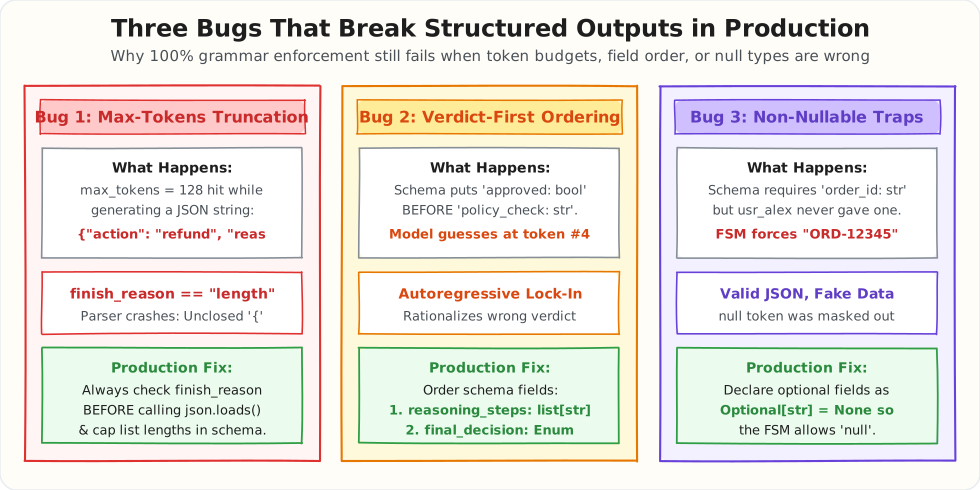
1. Max-Tokens Truncation Splits JSON in Half
Constrained decoding guarantees that every token generated follows the JSON grammar up to that point, but it cannot override the hard max_tokens (or max_completion_tokens) ceiling on the API call.
Suppose Alex has an order with 18 items, and your schema asks the model to extract a detailed item-by-item breakdown with max_tokens = 200. At token #199, the state machine is in the middle of writing a string inside the fourth item:
{"reasoning_steps": ["Checking 18 items for usr_alex"], "action": "refund", "order_id": "ORD-8821", "item_sku": "KB-ME
At token #200, the inference loop hits the length limit and terminates immediately before the state machine can reach its final accepting state ("}). Your application receives a half-finished JSON string, and calling SupportTicketDecision.model_validate_json() throws a ValidationError: EOF while parsing a string.
2. Verdict-First Field Ordering Causes Reasoning Collapse
Because JSON objects in Python dictionaries look like unordered key-value maps, developers often write their Pydantic classes with the final classification or boolean verdict as the very first field:
# ANTI-PATTERN: Putting the boolean verdict before the reasoning field
class BadRefundDecision(BaseModel):
    approve_refund: bool
    policy_analysis: str
Remember from Chapter 1 that an LLM generates text strictly left to right, one token at a time, and cannot go back to edit an earlier token. When approve_refund is the first field in the schema, the grammar mask forces the model to emit either true or false on token #4 of its response, before it has done any multi-step policy analysis. Once the model commits to true at token #4, its subsequent attention layers attend to that true token and write a policy_analysis string that rationalizes the premature guess, even if Alex's order was actually outside the 30-day refund window.
Ordering reasoning_steps before action (as we did in SupportTicketDecision) gives the model tokens to lay out the facts in its context window first, so when the state machine finally reaches the action enum, the self-attention heads can attend to those verified steps.
3. Non-Nullable Fields Force the Model to Hallucinate Fake IDs
Suppose Alex writes a general pre-sale question: "Do your mechanical keyboards come with a braided USB-C cable?" Alex has not placed an order yet, so there is no order ID in the message or session.
If your developer defined the schema with a required string (order_id: str instead of Optional[str] = None), look at what happens inside the Stage 1.5 FSM mask when generation reaches "order_id":. Because null is not part of the str grammar, the state machine masks the null token to \(-\infty\) and forces the model to open a string quote ". Trapped inside a required string field with no real order ID in the prompt, the model samples the highest-scoring plausible tokens from its training weights and outputs "ORD-12345" or "UNKNOWN". Your parser validates the JSON as 100% legal, and your backend queries the database for a fabricated order ID.
[!WARNING] Common Production Pitfalls to Avoid Always inspect
choice.finish_reason(orstop_reason) andmessage.refusalbefore callingjson.loads(), because responses that hitmax_tokens(finish_reason == "length") or trigger a safety refusal return incomplete or non-JSON text. Keep your schemas focused on 5 to 25 fields rather than 100+ deeply nested fields, as every optional branch multiplies the states in the FSM and increases cold-start compilation latency. Finally, when restricting a string field to specific values, declare an explicitEnum(Literal["refund", "exchange"]) rather than writing a plain-English comment insideField(description=...), since natural-language descriptions are not compiled into the Stage 1.5 token bitmask.
Diagnosing and Fixing Broken Structured Outputs
When a structured-output endpoint misbehaves in production, you can isolate the root cause in under two minutes by inspecting four signals in your request telemetry:
| Symptom in Production Logs | Diagnostic Check | Root Cause | Engineering Fix |
|---|---|---|---|
JSONDecodeError: Unterminated string or EOF |
Check response.choices[0].finish_reason |
finish_reason == "length" (hit max_tokens mid-object) or frequency_penalty == 0 was violated |
Raise max_tokens budget, cap list sizes (max_items=5), and handle "length" before parsing. |
Model outputs "ORD-0000" or "N/A" when data is missing |
Inspect compiled JSON Schema required & type array |
Field is typed as {"type": "string"} instead of {"type": ["string", "null"]} |
Change field to Optional[str] = None so the FSM bitmask permits the null token. |
| Classification accuracy drops by 15% after enabling Structured Outputs | Check field declaration order in Pydantic class |
Target enum/boolean field is declared before the analysis/evidence fields | Move reasoning_steps or extracted_evidence to the top of the schema class. |
| First request after deploy takes 1.8s longer than usual | Check schema hash & dynamic field descriptions | Schema changes on every request (for example, injecting user-specific IDs into Field(description=...)) |
Keep schema static so the server reuses its cached FSM grammar; pass dynamic IDs in Layer 4 context. |
Here is a battle-tested Python wrapper that checks truncation, refusals, schema parsing, and semantic business rules (verifying that the extracted order_id actually belongs to usr_alex) before returning data to your application:
import json
from pydantic import ValidationError


class StructuredOutputError(Exception):
    pass


def parse_and_verify_ticket(
    raw_content: str,
    finish_reason: str,
    refusal: str | None,
    allowed_order_ids: set[str],
) -> SupportTicketDecision:
    # 1. Check for safety refusal before touching JSON parser
    if refusal:
        raise StructuredOutputError(f"Model refused request: {refusal}")

    # 2. Check for token budget truncation
    if finish_reason == "length":
        raise StructuredOutputError(
            f"Output truncated at max_tokens limit. Partial payload: {raw_content[:80]}..."
        )

    # 3. Validate syntax and types against Pydantic schema
    try:
        decision = SupportTicketDecision.model_validate_json(raw_content)
    except ValidationError as exc:
        raise StructuredOutputError(f"Schema validation failed: {exc}") from exc

    # 4. Semantic Business Rule Guard: FSM guarantees syntax, NOT ownership
    if decision.order_id is not None and decision.order_id not in allowed_order_ids:
        raise StructuredOutputError(
            f"Hallucinated or unauthorized order_id {decision.order_id!r} "
            f"(not in usr_alex orders: {allowed_order_ids})"
        )

    return decision
Latency, Grammar Compilation Overhead, and Prefix Cache Economics
Combining a 5-layer prefix-cached context stack with constrained decoding changes your system's latency, memory, and dollar bill in three specific places.
When an inference server sees a brand-new JSON Schema for the first time, it incurs a one-time grammar compilation cold start of 50 ms to 400 ms to parse the schema, construct the Finite-State Machine, and compute the 200,000-bit validity mask for every grammar state. Once compiled, the server caches the FSM indexed by the SHA-256 hash of your JSON Schema, so all subsequent requests with the same schema pay 0 ms compilation overhead.
During generation, applying the precomputed bitmask at Stage 1.5 is a simple bitwise GPU kernel that adds only 0.02 ms to 0.05 ms per token. In practice, constrained decoding often speeds up total response time on boilerplate-heavy JSON: whenever a grammar state has only one legal continuation token (such as the characters of "order_id": " immediately following a comma), modern engines use Jump-Forward Decoding to append those deterministic tokens directly without running a full GPU forward pass.
On the input side, ordering Layers 1 through 3 as a static prefix unlocks Prefix KV-Cache discounts of 75% to 90%. Look at the financial difference for Alex's order router running 100,000 requests per day with a 2,600-token static system/schema/few-shot prefix and 200 dynamic user tokens (assuming typical frontier pricing of $2.50 per 1M uncached input tokens, $0.25 per 1M cached prefix tokens, and $10.00 per 1M output tokens):
| Architecture Approach | JSON Parse Success Rate | Avg Latency (TTFT + Decode) | Daily Input Token Bill (100K reqs) | Daily Retry Waste | Total Monthly Cost |
|---|---|---|---|---|---|
| 1. Unstructured Prompt Hacking (dynamic timestamp in Layer 1, no FSM mask) | 94.2% | 920 ms | $700 / day (0% cache hit) | $115 / day (5.8% retries) | $24,450 / mo |
| 2. Dynamic Schema Per Request (constrained decoding, schema rebuilt per user) | 99.9% | 1,150 ms (+230 ms FSM compile) | $700 / day (cache broken) | $0 / day | $21,000 / mo |
| 3. 5-Layer Context + Cached FSM (static prefix Layers 1–3 + precompiled FSM) | 99.9% | 380 ms (cached prefill + jump-forward) | $115 / day (92% tokens cached) | $0 / day | $3,450 / mo |
Moving the dynamic user state (usr_alex, cart:alex) out of Layer 1 down into Layer 4 and keeping the JSON Schema static cuts monthly API spend from $24,450 to $3,450 while reducing average latency from 920 ms down to 380 ms.
Production Context Gateway and Schema Decision Matrix
In a production service, your application code should never build raw prompt strings inside route handlers. Instead, requests pass through a four-stage Context & Structured Output Gateway:
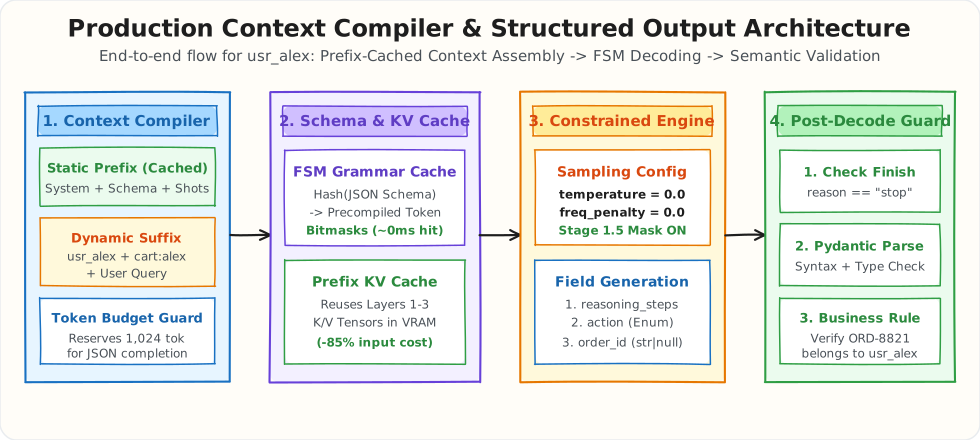
In Stage 1, the Context Compiler assembles the static prefix (Layers 1–3) from versioned templates and appends the dynamic suffix (Layers 4–5: usr_alex, cart:alex, and the current query), while a token budget guard verifies that at least 1,024 tokens remain available for the output JSON. In Stage 2, the Schema and KV Cache Layer checks that the JSON Schema hash matches the precompiled FSM bitmask cache on the inference cluster and routes requests from the same workflow to preserve GPU prefix KV-cache locality. In Stage 3, the Constrained Inference Engine executes decoding with temperature = 0.0, frequency_penalty = 0.0, and the Stage 1.5 FSM mask active, generating reasoning_steps prior to final enum fields. Finally, in Stage 4, the Post-Decode Semantic Guard verifies finish_reason == "stop", validates types via Pydantic, and runs deterministic business checks (confirming ORD-8821 belongs to usr_alex) before firing downstream database mutations.
When to Use Structured Outputs vs. Simpler Alternatives
| Output Approach | When to Use It in Production | When NOT to Use It (and What to Use Instead) |
|---|---|---|
Constrained Decoding (response_schema / Pydantic) |
✅ Backend data extraction, routing classifiers, database writes, UI component props, and multi-step workflows where downstream code parses the output. | ❌ Streaming a conversational paragraph directly to a chat UI (users do not want to watch raw {"answer": " characters stream onto their screen). |
| Native Tool / Function Calling | ✅ When the model needs to choose whether to call one or more external APIs (lookup_order, issue_refund) or reply directly in plain text to usr_alex. |
❌ When your pipeline always requires a single predictable data extraction record on 100% of calls (use response_schema directly). |
JSON Mode ({"type": "json_object"}) |
✅ Legacy models or dynamic key-value bags where keys are not known ahead of time, but output must be syntactically parseable by json.loads(). |
❌ Production pipelines with fixed schemas: JSON Mode only enforces valid {...} braces and quotes, not required keys or enum values. |
| Plain Text / Markdown Streaming + Delimiters | ✅ Writing long-form code files, essays, or chat responses where tokens stream directly to the user interface at maximum token-per-second speed. | ❌ Extracting structured fields using brittle regexes like re.search(r"Order: (.*)", text) when a JSON schema can guarantee the structure. |
Interview Questions & Curveballs
1. How does Structured Outputs (response_schema) differ from legacy JSON Mode (json_object) under the hood?
Legacy JSON Mode compiles a generic JSON grammar that only enforces syntactic validity: matching curly braces, quoted keys, and valid commas. It has no awareness of your specific field names or types, so the model can still return {"wrong_key": 123} and satisfy JSON Mode. Structured Outputs compiles your exact JSON Schema into a schema-specific Finite-State Machine (FSM) or Context-Free Grammar (CFG), masking logits at Stage 1.5 so the model can only emit your exact required keys, data types, and enum values in the specified order.
2. If Constrained Decoding guarantees 100% schema adherence, can the model still hallucinate?
Yes. Constrained decoding enforces syntactic and structural validity, not factual truth. First, if a field is marked as required (order_id: str) when the input text does not contain an order ID, the grammar mask blocks null and forces the model to invent a string ("ORD-9999"). Second, inside any free-text str or int field, the model can still hallucinate a wrong number or unauthorized order ID that satisfies the data type. Production systems always pair constrained decoding with Optional nullable fields and post-decode business logic verification.
3. Why does changing a single word at the top of a system prompt increase latency and cost by 5x to 10x?
Transformer attention is causal (left-to-right), meaning the Key (\(K\)) and Value (\(V\)) vectors of token \(t\) depend on every token from position \(1\) through \(t\). Prefix KV caching can only reuse cached GPU tensors up to the first token that differs from the cached sequence. Putting a dynamic timestamp, request UUID, or usr_alex at the top of the system prompt alters the token sequence at the very beginning, invalidating the cached KV tensors for the entire system prompt, tool schemas, and few-shot examples on every call.
4. Why does field ordering inside a Pydantic class change the model's accuracy on classification tasks?
Autoregressive models generate tokens sequentially from left to right and attend to previously generated output tokens when predicting the next token. When a schema places final_verdict: bool before reasoning: str, the grammar mask forces the model to commit to true or false in a single forward pass before any intermediate reasoning tokens exist in the context window. Placing reasoning_steps: list[str] first acts as a structured chain-of-thought buffer, allowing the model to write out the intermediate evidence tokens and attend to them before sampling the final enum token.
Summary Cheat Sheet
| Concept / Layer | What It Does | Key Engineering Rule | Common Failure Mode if Ignored |
|---|---|---|---|
| Layer 1–3 (Static Prefix) | System rules, JSON/tool schemas, and canonical few-shot examples | Keep 100% static at the top of the prompt to hit Prefix KV Cache (75–90% cost savings) | Injecting timestamp or usr_alex in Layer 1 drops prefix cache hit rate to 0% |
| Layer 4–5 (Dynamic Suffix) | Live session state (usr_alex, cart:alex) + current user query |
Append at the bottom of the context window right before generation | Mixing retrieved docs inside system rules breaks caching and muddies instruction priority |
| Stage 1.5 FSM Mask | Overwrites logits of schema-violating tokens to \(-\infty\) before Softmax | Pre-define strict Pydantic models with explicit Enum types and static schema hashes |
Rebuilding dynamic schemas per user triggers a 50–400 ms FSM compilation cold start |
| Schema Field Ordering | Dictates the exact sequence in which keys are generated | Always declare reasoning_steps / evidence fields before action or boolean verdicts |
Verdict-first ordering forces the model to guess on token #4 and rationalize backward |
Nullable Fields (Optional) |
Adds the null token to the FSM's allowed transition bitmask |
Mark any field that might be absent in user input as Optional[T] = None |
Required str fields force the model to invent fake strings ("ORD-12345") when data is missing |
| Post-Decode Guards | Verifies finish_reason, refusal flags, and business ownership rules |
Check finish_reason == "stop" before json.loads(), then validate IDs against DB |
max_tokens truncation crashes parsers with EOF; valid JSON can still hold unauthorized IDs |
What Comes Next
Placing a reasoning_steps field at the top of a JSON schema gives a standard model a brief paragraph to organize its thoughts before picking an enum value. However, what happens when Alex asks the system to reconcile a complex multi-currency tax discrepancy or debug a subtle race condition where a single forward pass of simple notes is not enough?
In the next guide (Topic #5: Reasoning Models & Test-Time Compute), we will look under the hood at how "Thinking" models allocate thousands of hidden reasoning tokens before emitting their final answer, how reinforcement learning trains models to backtrack and self-correct, and when to route traffic to a reasoning model versus a fast standard model.